
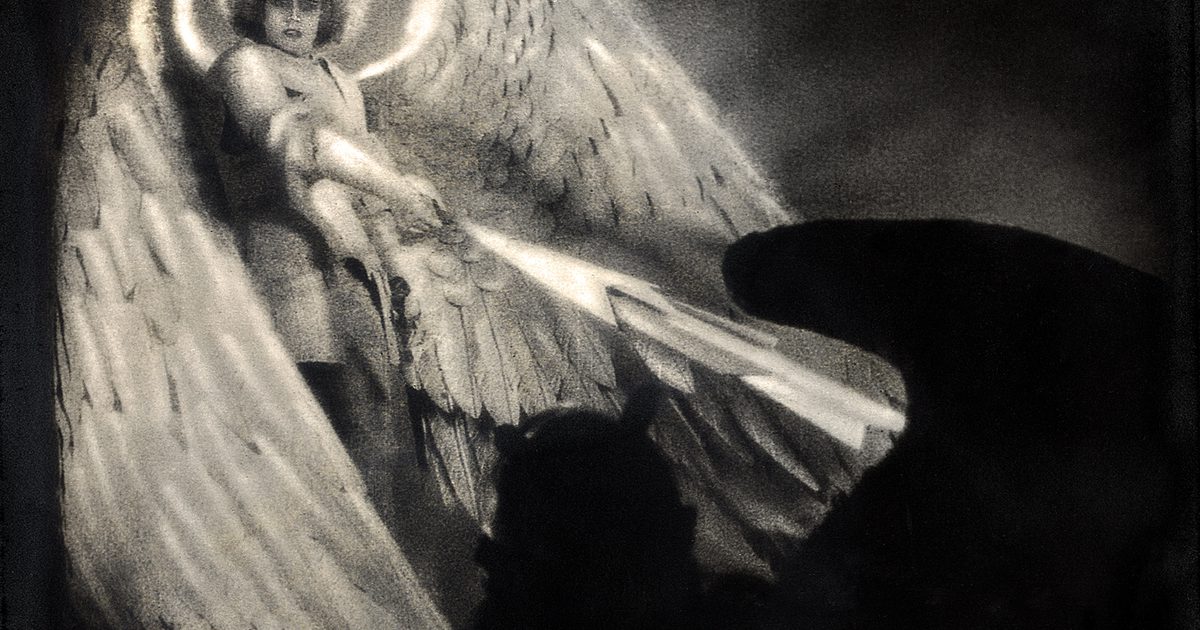
Mystery is something that remains thoroughly connected to the influential German director FW Murnau – both in terms of his work and their fate, as well as to his mythology. It is devilishly tempting to view this air of mystery in connection to Murnau’s singular ability to capture the supernatural. Several Murnau pictures are lost in their entirety, includingSatanand4Devils,while others – 1922’sPhantom,The Burning Soil,Nosferatu: ASymphony of Horror,and 1930’sCity Girl–have been reinstated in various degrees, accompanied by intriguing stories of near-loss and resurrection: fires, government orders for destruction, and aprint discovered in an Italian asylum.
In her study of German Expressionism,‘The Haunted Screen’, Lotte Eisner wrote that “no other director, not even [Fritz] Lang, ever succeeded in conjuring up the supernatural as masterfully as [Murnau].” Although this reputation has somewhat overshadowed an entire filmography, which also includes great works of mystery, romance and drama, it is nonetheless accurate and seductive to consider the director’s exquisite gift for phantasmagorical conjurings.
Get more Little WhiteLies
Murnau’s final German film, 1926’sFaust,proclaims to depict the opening of the gates of hell, – agrand infernal spectacle that cements his reputation for cinematic darkness. Adapting Johann Wolfgang von Goethe’s play with meticulous detail and bringing forth its eschatological themes, the film opens with awager between Heaven and Hell via the Archangel and Mephisto. Mephisto bets that he can wrest the soul of alchemist Faust away from God, and if successful, he shall claim Earth. The demon unleashes aplague, and as Faust looks for acure, the ensuing deaths and chaos inspire acrisis of faith in the townsfolk. Disillusioned, Faust swears an oath to the lord of darkness and makes ablood-pledged deal with the devil for aday’s trial of power,but is soon tricked into the temptations of hedonism and regained youth. When the trial ends, Faust agrees to surrender his soul to continue his pleasures, and having exhausted all delights, he falls in love with the virtuous Gretchen. Eventually, Faust and Gretchen die together, the union of their tragic love bringing an end to Mephisto’s claim to theEarth.
Murnau’s on-screen conjurings would intriguingly intertwine with his off-screen life, retroactively adding to their allure through lore and legend. Directly following the production ofFaust, he left for Hollywood, having been signed by studio head William Fox, who subsequently gave Murnau creative freedom to make his ambitious American debut,Sunrise: ASong of Two Humans. In May 1929, the film took home the special Academy Award for Best Unique and Artistic Picture – the only one of its kind in Oscars history.
However, the sweet smell of success would soon sour. Soon after the ceremony, Fox was in aserious automobile accident and by October of that year, he hadlost alarge part of his fortune during the Wall Street Crash. By 1930,he’d lost control of the studio and was later jailed on bankruptcy related charges ofconspiring to obstruct justice and defraud the United States. The following year, Murnau died tragically in an automobile accident. In astrange parallel to Fox’s accident – where Fox had survived but his chauffeur was killed – Murnau, alone in the back seat, was the sole fatality. The signing of acreative genius by awealthy studio head who would together make Hollywood’s only Unique and Artistic Picture before falling into ruin has, at the very least, atinge of the Faustian bargain to it, at least in the way it is oftentold.
Salacious myths persisted around Murnau’s death, including ascandalous rumour perpetuated in ashort passage of Kenneth Anger’s infamous book‘Hollywood Babylon’. Anger’s apocryphal assertion that Murnau had been performing asexual act on an underage boy at the wheel at the time of his deathcontinues to circulate, even if only in telling of his chauffeur’s efforts to dispel the rumour. In relation toFaust, this mythical version of events places Murnau as the cursed genius meeting his fate amidst the moral corruption of ascandal-ridden hedonistic pre-Hays Code Hollywood. Viewed through acentury of aseemingly “cursed” legacy, these events seem significant and tantalising. Even the master negative forSunrisewould perish in the 1937Fox Vault Fire, with the film still the subject ofrestoration efforts in2026.