
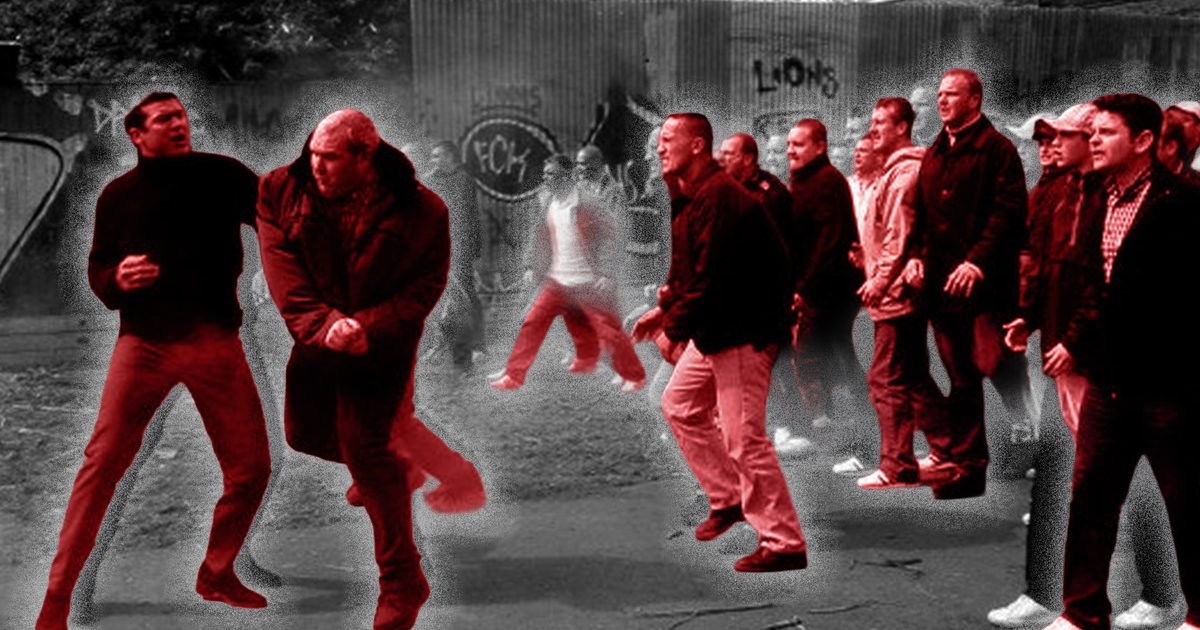
Here we see the flipside of this narrative of exclusion: if we are going to be treated as violent scum, then we shall wear it as abadge of pride. Of course, this is atidy gloss on amuch more complex cultural issue. Football hooliganism was never simply an innocent pastime unfairly vilified by abourgeois media, but was in fact the pastime of upwardly mobile professionals and far-right thugs.
In fact, what the British crime film scholar Paul Elliott calls the ‘Gangster Light’ film, with its mixing of late 1990s New Lad sensibilities and ‘decontextualised and heavily edited images of England’s cultural and criminal past,’ offers an insight into the closed tribal mindset that modern nationalism often preys on: ‘England till Idie,’ close-knit and ethnically well-policed. Perhaps as aresult,the synopsis forThe Football Factoryends up giving too much away: “The Football Factory is more than just astudy of the English obsession with football violence, it’s about men looking for armies to join, wars to fight and places to belong. Aforgotten culture of Anglo-Saxon males fed up with being told they’re not good enough and using their fists as adrug they describe as being more potent than sex and drugs put together.”
This is afalse, nativist mythology – an attempt to reframe the English Disease as part of innate folk culture. This conception of the English working-class has become the dominant narrative pushed onto our screens by the far-right, afalse consciousness that scapegoats migrants and those on benefits.
Love also turned out aremake of Alan Clarke’sThe Firm, tuning down the more explicitly critical elements of the film in favour of aglossy ’80s pastiche of shell suits and Soft Cell. Clarke, for his part, chose to remain distant from his subject matter,turning down offers to meet with real football firms as he abhorred how they exploited his favourite sport. Instead, he used their violence as an avenue to explore the curdling of British masculinity, and the neglect of working-class institutions under Thatcher.
In addition, films such as Roland Joffe’s 1978The Spongersand David Edgar’sDestiny,from the same year,also explored conditions of deprivation, resentment and violence. Crucially, these films approached their subjects with acritical eye, refusing to take stereotypes of race and class for granted. This could be attributed to the relatively diverse (for the 1970s) team of writers and directors commissioned for the series; artists who often brought their own experiences of growing up in Britain’s class-riven society to their work. By the 2000s, decades of artistic disenfranchisement – the closure of the working men’s club and the local theatre – had excluded all but the most determined working-class artists. As aresult, their narratives were boiled down to either ‘aspirational’ stories of individual success, or condemned as examples of afailing society.
Within artistic circles, there is aconstant, churning debate about the ability of art to adequately depict and dissect our digital hellscape. Images have become untrustworthy, online narratives bleed out into our world in the form of shocking acts of vigilantism and rioting. What many of the crime films that Britain produced in the early 21st century seem to lack is asense of scepticism about the country they claim to depict – areluctance to look behind the topline. This trickles down into our received attitudes about the state of the country, unravelling the fabric of truth and establishing false and harmful stereotypes. It’s these illusions that allow the likes of Robinson and Musk to turn communities against eachother.
Through the ASBOwave’s combination of ironic masculinity and cruel violence, the UK film industry found itself towing the line of the dominant ideology: one that scapegoats those most abjected by society – the poor, the refugee – when it has in times past shown that it is capable of challenging the official narrative. This is the industry that produced Franco Rosso’sBabylon, Raine Allen-Miller’sRye Lane, the works of Steve McQueen, and innumerable other films that tell adifferent story of the country. Acountry that the writer Paul Gilroy identified as convivial and multi-ethnic, broadly at ease with difference, yet occasionally stoked to post-imperial rage by bad actors. Despite its past failures, British film still has the potential to reckon with modern life in Britain, to challenge doomsaying and division, if it can only rise to the challenge.