

It’s now been 36 years since the Isabella Stewart Gardner Museum in Boston became the victim of thelargest unsolved art heistin history.
On March 18, 1990, 13 pieces of art worth more than $500 million were stolen from the museum by thieves posing as police. None of it has been recovered and no one has been arrested.
The empty gold frames on the walls of the Dutch Room at the museum today might be the most famous empty frames in the world.
“It’s a tangible reminder of what’s missing, and I think it really needs to go back,” said retired FBI agent Geoffrey Kelly.
Kelly just released his first book detailing a case that even he admits still haunts him. Called “Thirteen Perfect Fugitives,” Kelly describes his time on the case in the first person.
David L Ryan/The Boston Globe via Getty Images 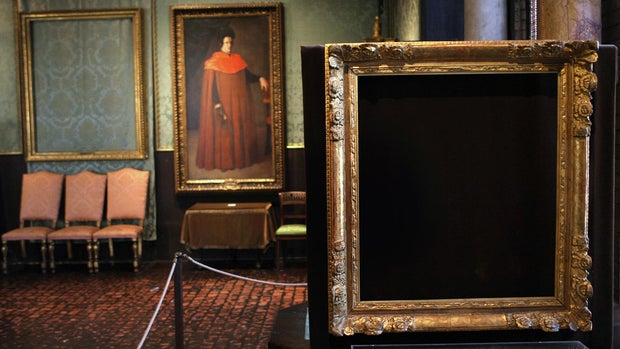
Kelly spent 22 years of his career trying to solve the case and find the art that was stolen, including Rembrandt’s “Christ in the Storm on the Sea of Galilee.”
“I would be lying if I said that this wasn’t the one big case that I wanted to go out and retire with a recovery and I felt like something was kind of left undone when I retired from the FBI and perhaps writing this book was a cathartic exercise for me,” he said.
Informants tracked art to Connecticut, Philadelphia
According to Kelly, the “whodunit” part of the case is solved. He believes it was taken by a mob job crew out of Dorchester and his reliable informants helped track the art to Connecticut and Philadelphia. However, numerous search warrants turned up empty and the alleged main players in the heist have all since died.
What was their motive?
“Most likely to hold onto the Rembrandt that they stole as kind of an insurance policy in case they got locked up for something. It’s something that we’ve seen historically in Massachusetts,” Kelly explained, referencing a 1972 Worcester heist. “They use those stolen Rembrandts as leverage to get a break on pending sentences.”
Kelly described tips from an informant nicknamed “Meatball,” including driving a poultry truck with the art concealed in boxes in its bed. “Meatball” later told Kelly that Connecticut mobster Bobby Gentile told him the art was “‘Worth nothing. It’s worthless. Nobody wants it.’ Which is the irony of stealing high-end art,” Kelly said.
How will the stolen art be found?
In Kelly’s opinion, the entire focus is now on retrieving the stolen art.
“I’ve been asked that question so many times about do you think they will ever be found? And my answer is yes. Recoveries usually occur right after the theft occurs or it’s going to be generational,” he said. “Somebody’s going to pass away, and the family is going to be going through the attic or the safety deposit box and they’re going to come upon something that was stolen at some point.”
Isabella Stewart Gardner Museum Chief Investigator Anthony Amore agrees about the generational return, but he’s invested two decades of his career into personally bringing back the stolen art.
“I envision the day that I recover them and bring them back myself. I know that that’s going to happen. I don’t know how it’s going to happen or when,” he said.
When it does happen, many of the works will be returned to their home in the Dutch Room at the museum, which is currently under a major floor-to-ceiling restoration.
“This is their only true home,” Amore said.
How tips are fact-checked
Amore regularly receives information from people claiming to have the paintings. He has a quick way of fact-checking them.
“Oh, that’s fantastic, now send me the back,” Amore tells them. “And they send me the back with what they think is on the back, but they don’t know what’s on the back [of the art] so they make these hand painted efforts to try to convince us and it’s almost comical.”
For investigators like Amore and Kelly, returning the art to its home is the only goal.
“The empty frames that were on the wall, for me working this case for 22 years… It was always a little haunting to see the empty frames,” Kelly said.