
Good luck picking up the books on anunofficial summer reading listfromthe Chicago Sun-Times.
Hoping to delve into the “multigenerational saga”Tidewater Dreamsby IsabelAllende, for instance? Keep dreaming. Maybe a science-driven story like Andy Weir’s The Last Algorithm is more to your taste? The algorithm can’t help you.
OK then, how about Min Jin Lee’s “riveting tale set in Seoul’s underground economy,” Nightshade Market? Sorry— all you’re going to find is shade.
That’s because, while the authors may be real, the books don’t actually exist. And theChicago Sun-Timesis being roasted onlineforpublishing the AI-generated list.Thepaper initially couldn’t explain how the piece was published.
“We are looking into how this made it into print as we speak. It is not editorial content and was not created by, or approved by, the Sun-Times newsroom. We value your trust in our reporting and take this very seriously. More info will be provided soon,”theChicago Sun-Times wrote on the social media platform Bluesky on Tuesday morning.
In a statement to CBC News,Chicago Sun-Times spokesperson Victor Lim further explained that the insert was “licensed editorial content from King Features, a unit of Hearst, that was not created by, or approved by, the Sun-Times newsroom.”
“But it is unacceptable for any content we provide to our readers to be inaccurate,” he added.
King Features is an American content producer. Lim explained that the newspaper has historically relied on content partners for broader coverage beyond their primarily local scope, but “given recent developments, it’s clear we must actively evaluate new processes and partnerships.”
In a statement to CBCNews, TheSun-Times Guild— the union that represents editorial employees at the newspaper— confirmed that the summer guide was a syndicated section produced externally “without the knowledge of the members of our newsroom.”
“We’re deeply disturbed that AI-generated content was printed alongside our work. The fact that it was sixty-plus pages of this ‘content’is very concerning — primarily for our relationship with our audience but also for our union’s jurisdiction,” the guild wrote.
“Our members go to great lengths to build trust with our sources and communities and are horrified by this slop syndication. Our readers signed up for work that has been vigorously reported and fact-checked, and we hate the idea that our own paper could spread computer- or third-party-generated misinformation. We call on Chicago Public Media management to do everything it can to prevent repeating this disaster in the future.”
Real authors, fake books
On Tuesday morning, social media users started sharing a “Heat Index” insert from theChicago Sun-Times datedMay 18. Included in the index was a “Summer reading list for 2025,” described as “15 titles, new and old, that promise to deliver the perfect summer escape.”
The problem, as readers were quick to point out, is thatmost of the books in the list are fake.
“Of the books named on this reading list, Brit Bennett, Isabel Allende, Andy Weir, Taylor Jenkins Reid, Min Jin Lee, Rumaan Alam, Rebecca Makkai, Maggie O’Farrell, Percival Everett, and Delia Owens’ titles are all books that DO NOT EXIST!!!” wrote Bluesky user Bracken MacLeod.
Indeed, a quick search of the 15 books in the list show that nine simply do not exist. Chilean-American author Allende, for instance, has written dozens of books, but none of them are called Tidewater Dreams. (CBCNews couldn’t find any fictional book with that title, in fact.)
The Chicago Sun Times had AI write about summer books…and it included some that don’t exist. Cool, cool. Could’ve paid me or someone else, you know? This is what I do. But yeah, go with AI slop. Do you. pic.twitter.com/Jinh8MyIEG
Lee has been internationally laudedfor her books Free Food for Millionaires and Pachinko(a finalist for The National Book Award), but has not written anything called Nightshade Market (nor has anyone else, from what CBC News can tell).
Fans of bestsellerTaylor Jenkins Reid, who also appears on the list, could easily tell youthe author of hits likeDaisy Jones & the Six and The Seven Husbands of Evelyn Hugo has never written anything called The Collector’s Piece.
The book credited to Maggie O’Farrell, Migrations, appears by its description to be authored by Charlotte McConaghy.
There are afew books called Salt and Honey, the 10th book on the list,but it’s not written by bestselling author Delia Owens, and none of the books called Salt and Honey are actually “set in the salt flats of Utah,” as the insert says.
Only the last five books on the listof 15 are real, and penned by the correct authors.
But …how?
The list was generated by freelancerMarco Buscaglia, a Chicago-based writer, content strategist and teacher. He confirmed that he failed to fact check what he gleaned using AI.
“Stupidly, and 100 per centon me, I just kind of republished this list that [an AI program] spit out,” he said in a statement published Tuesday evening by the Chicago Sun-Times.
“Usually, it’s something I wouldn’t do,” he added. “I mean, even if I’m not writing something, I’m at least making sure that I correctly source it and vet it and make sure it’s all legitimate. And I definitely failed in that task.”
Some social media users have said it appears other articles in the Heat Index may have also been AI-generated, pointing to experts who don’t seem to exist. For instance, screenshots of an article called “Summer food trends” quotes a food anthropologist named Catherine Furst of Cornell University, who can’t be found on the internet.
Another screenshot of anarticle about “campus hammock culture” appears to quote a professor of leisure studies who also, evidently, can’t be traced online.
Buscaglia confirmed this in his statement, saying he used AI for other stories in the special sectionand couldn’tguarantee he fact-checked those articles completely.
King Features, in the same statement, said it was terminating its relationship with Buscaglia, adding that his use of AI violated a “strict policy.”
“We regret this incident and are working with the handful of publishing partners who acquired this supplement,” a spokesman for King Features said. At least one of those partners includes thePhiladelphia Inquirer.
AI can make mistakes. They’recalled hallucinations —errors that occur when the system lacks sufficient context.
TheNew York Timesreported earlier this month that AI hallucinations are getting worse instead of better, producing incorrect information more often as “AIbots tied to search engines like Google and Bing sometimes generate search results that are laughably wrong.”
‘A learning moment’
This also isn’t the first time media outlets have come under fire for using AI-generated content. Sports Illustrated, for instance, made headlines in 2023 for reportedly using AI-generated authors.News outletCNET had to issue a number of major corrections that same year after using AI to help write its stories.
And who can forget the time an allegedlyAI-generated Microsoft article recommended the “beautiful” Ottawa Food Bank as a touristy lunch spot?
AsNPR reports, the Sun-Times’fake summer reading list was published two months after the paper announced 20 per cent of its staff had accepted buyouts.
In its statement, the Chicago Sun-Times said this “should be a learning moment for all of journalism that our work is valued.”
The article is being removed from digital editions, according tothe statement.It said that the paperwasupdating itspolicies to “ensure that all such third-party licensed editorial content meets the same editorial standards as content we create ourselves.”
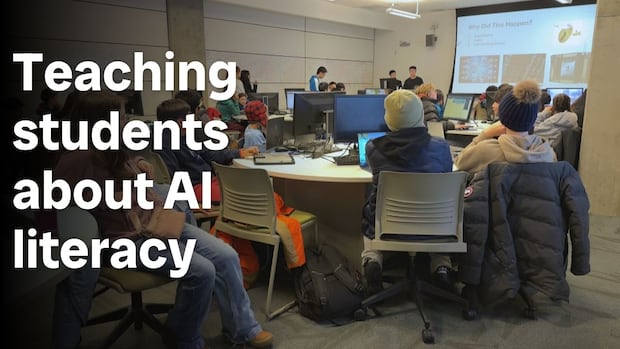
A group of Calgary high school students is offering free courses on artificial intelligence to younger students. The classes are open to kids in grades seven to 10, take place at the University of Calgary library, and aim to teach students how to responsibly use AI tools like ChatGPT.